
Risk Assessment System
Turning Human Judgment into Computable Risk Intelligence
A major insurance institution had long relied on field inspectors’ personal experience and manual calculations for risk assessment. Each senior inspector carried their own assessment logic — but this logic couldn’t be passed down, verified, or scaled. As case volumes grew and staff turned over, maintaining consistency in assessment quality became a critical challenge.
Our mission wasn’t to digitize paper forms. It was to transform the risk judgment inside experts’ heads into a computable, calibratable, and continuously improvable assessment engine.
The Challenge: Expertise Doesn’t Scale
- Inconsistent results: Different inspectors could assign different risk grades and coefficients to the same property
- Knowledge drain: Risk calculation logic lived in senior staff’s minds — when they left, it left with them
- Black-box reviews: Managers could only see the final numbers, with no way to trace how each judgment was made
- High revision costs: When reports were rejected, staff had to dig through records and recalculate from scratch
The Solution: An End-to-End System from Field Collection to Risk Pricing
Structured Data Collection — Turning Field Observations into Computable Data
We decomposed field inspections into multi-dimensional structured inputs, accessible on both desktop and mobile devices. Inspectors can complete standardized data collection on-site — no more free-form notes, but structured data ready for computation.
Risk Computation Engine — Replacing Experience-Based Judgment with Consistency
This is the core of the system. The engine integrates inspection data to automatically compute risk coefficients and grading recommendations, ensuring every assessment is based on the same computational logic rather than individual experience. Model parameters are configured and calibrated by the client, ensuring full ownership and confidentiality of risk logic.
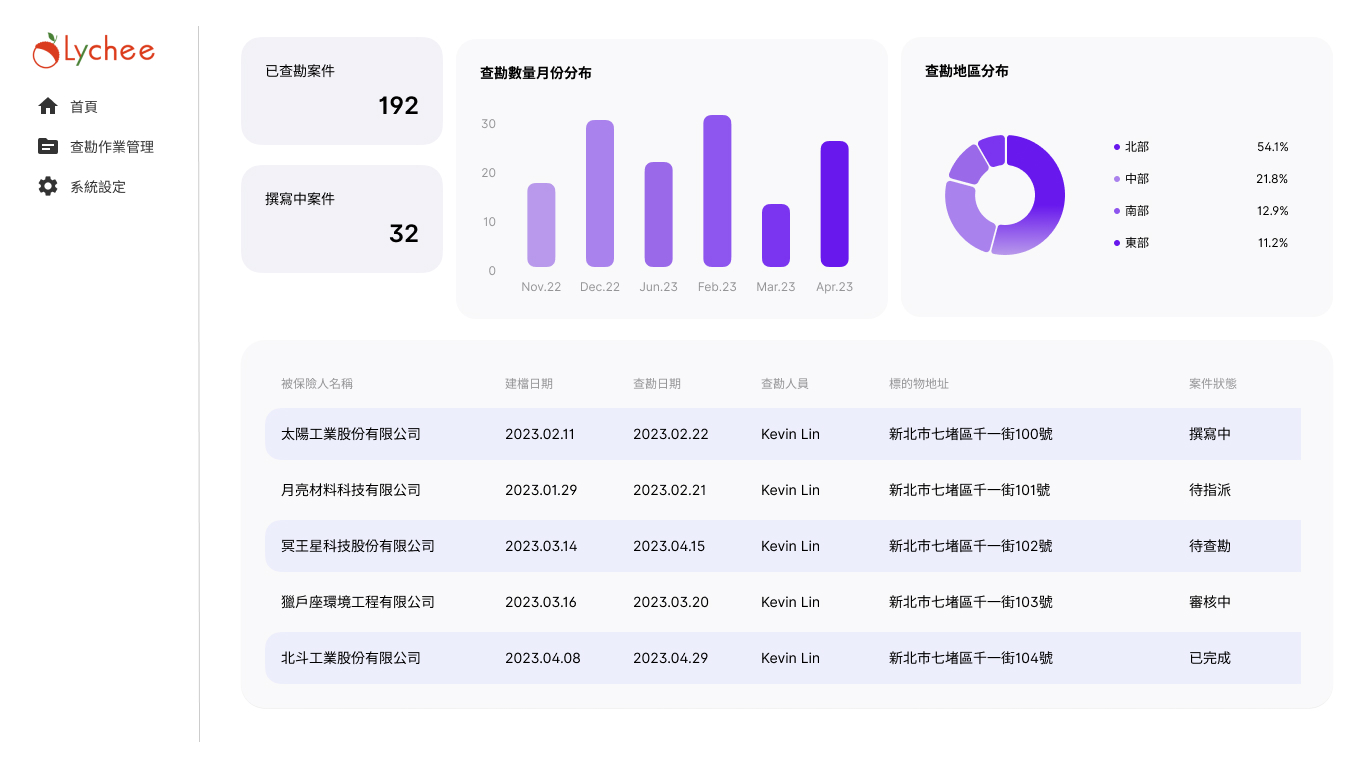 The image above is illustrative. Actual interfaces are customized per client requirements and cannot be disclosed due to confidentiality agreements.
Explainable Results — Not Just Answers, but Reasoning
The biggest fear in risk assessment isn’t getting it wrong — it’s not knowing how it was calculated. Every risk grade produced by the system can be traced back to its corresponding inspection data and computation factors, allowing review managers to examine the reasoning directly, not just a final number.
Review Workflow — Fully Traceable from Submission to Delivery
From case creation, assignment, inspection, computation, and preview to submission, every step has clear status tracking and accountability. When reports are rejected, the system retains all data and computation records — revisions trigger a one-click recalculation without starting from scratch.
The Impact
| Before | After |
|---|---|
| Risk assessments varied by person, consistency hard to control | Assessments based on unified computational logic, results comparable and calibratable |
| Senior staff departure meant immediate quality decline | Risk knowledge embedded in the system, new hires can complete assessments with guidance |
| Managers could only see the final report, not the judgment process | Every risk factor’s source and weight fully traceable |
| Report rejections required manual data retrieval and recalculation | Structured data preserved, one-click recalculation after revisions |
Who Is This For?
The core problem this system solves: How to transform expert-dependent judgment into a systematic capability the organization can own and control.
If your team faces a similar challenge — whether in risk assessment, field inspection, quality auditing, or any scenario requiring “scalable professional judgment” — we’d love to talk.