
Conversational Insurance Experience on LINE
Replacing Forms with Conversation — So Users “Complete It Before They Know It”
We designed a conversational insurance experience on LINE for an insurance institution. Instead of facing a full page of form fields, users moved through a natural conversation — from clarifying needs and receiving policy recommendations to filling in details and completing payment — every step guided within the conversation, always knowing where they were and what came next.
This project taught us something fundamental: A good conversational experience isn’t about splitting a form into chat bubbles. It’s about redesigning the entire logic of “what to ask when, how to ask it, and what to do after the answer.”
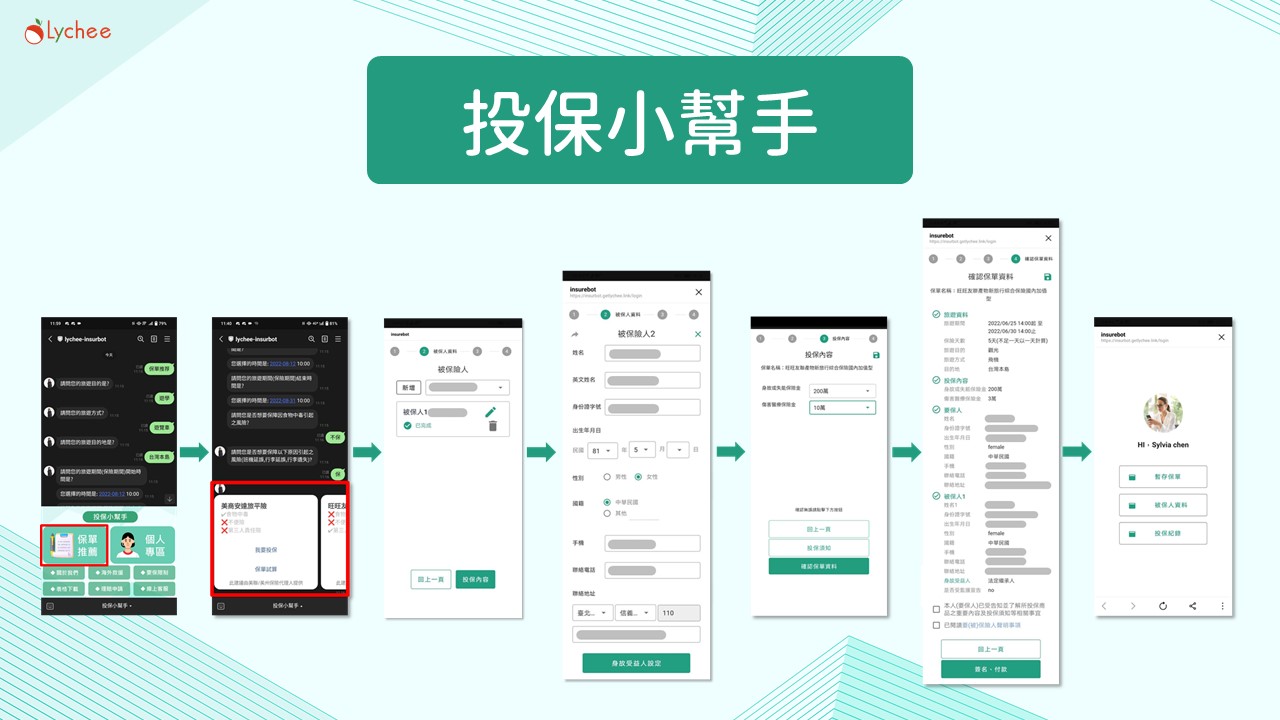 The image above illustrates the interaction flow. Actual interfaces are customized per client requirements and cannot be disclosed due to confidentiality agreements.
The Challenge: A Complete Process That Users Couldn’t Complete
Travel insurance is a classic “urgent need, long process” scenario. Users often remembered they needed insurance right before departure, but faced:
- Choice paralysis: Too many plans, no idea how to choose — overwhelmed by information, many simply gave up
- Form fatigue: Policyholder, insured person, beneficiary, terms acceptance — each field reasonable, but all on one page made users feel exhausted, with drop-offs typically happening mid-form
- Last-mile breakdown: If the handoff to signature and payment wasn’t seamless, users would stall on the confirmation page, leaving behind an incomplete application
For the business, these friction points directly impacted completion rates and customer service costs.
The Solution: Redesigning “What to Ask When”
Understand the Need First, Then Recommend
Rather than presenting a product catalog for users to compare themselves, structured conversation clarified travel purpose, method, and duration, then recommended suitable plans based on responses. Users felt “it understands what I need” instead of “I have to figure this out myself.”
Break the Long Form into Small Tasks
The insurance process was decomposed into clear conversational segments: each step handled only one thing, advancing to the next only upon completion. Users weren’t overwhelmed by a full page of fields, and were less likely to get lost or make errors. Previously entered data (like policyholder information) was automatically pre-filled for subsequent purchases, eliminating the friction of repetitive data entry.
Make “Submit” Actually Mean “Done”
After the conversation concluded, the system seamlessly bridged to the signature and payment flow. For users, the experience from need clarification to payment completion was one continuous journey — it didn’t break at the most critical conversion step.
The Impact: From “Give Up at First Sight” to “Done Before You Know It”
| Before | After |
|---|---|
| Users faced a full page of forms, abandoned halfway through | Conversational step-by-step guidance, each step clear and completable |
| Product catalogs left users to compare on their own, decision paralysis | Conversation clarified needs then recommended plans, reducing decision pressure |
| Repeat purchases required re-entering all information | Historical data auto-populated, repeat purchases completed faster |
| Signature and payment handoff was broken, completion stalled at the last step | Seamless end-to-end flow, critical conversion step stays connected |
From Chatbot to AI Agent: The Same Experience Design Principles
This project was completed before “AI Agent” became a buzzword, but the design principles we accumulated are exactly what building a good AI Agent requires today:
- Intent understanding: Not waiting for users to issue precise commands, but progressively clarifying real needs through conversation
- Flow orchestration: Knowing when to ask, when to act, and when to hand off to the next stage
- Friction control: Every interaction point works to reduce the chance of abandonment, not just “technically functional”
- Task completion orientation: The goal of the entire conversation isn’t to answer questions — it’s to guide users to complete a task
Today’s AI Agents are smarter than the chatbots of the past, but “smart” doesn’t mean “usable.” An AI Agent without experience design is just a form that talks.
What Scenarios Does This Fit?
If you’re planning an AI Agent, LINE Official Account, or any conversational service, and your scenario matches these characteristics — let’s talk:
- Multi-step processes with many fields where users easily abandon midway
- Need to recommend options based on user conditions rather than letting users browse
- Want to deliver conversational guided experiences within LINE, Web, or App
- Deploying AI Agents but unsure how to design conversational flows that actually improve conversion rates